Relief in 4 to 6 Sessions: TMJ Massage Benefits Backed by RCTs

Yes: for most people with TMJ-related jaw pain, targeted massage reduces pain and improves how wide the jaw opens. The strongest results come when massage is paired with therapeutic jaw exercises rather than used alone. Clinical trials back this up with measurable outcomes, not just anecdotal relief, and a safe self-massage routine can extend the benefits between clinic visits.
TL;DR:
Targeted massage combined with therapeutic exercises produces greater pain relief and improved jaw mobility than massage alone, according to clinical trials.
Most patients notice measurable improvements after four to six sessions, with sustained benefits heavily dependent on continuing home exercises.
Self-massage routines should be performed twice daily, focusing on the masseter, temporalis, and neck muscles, and adjusted if soreness persists.
Combining manual therapy with exercises addresses muscle retraction and prevents regression of gains over time, unlike massage-only approaches.
A professional assessment is recommended if pain worsens, new neurological symptoms appear, or relief plateaus after several sessions.
Table of Contents
TMJ massage benefits you can actually expect
The benefits of jaw massage for TMJ disorders aren’t vague promises. Clinical research ties them to specific, measurable outcomes, and understanding what’s realistic helps you judge whether it’s worth adding to your routine.
Pain relief tends to show up fast. People undergoing manual soft tissue therapy for TMJ pain often report reduced discomfort within a single session, faster than many self-directed stretching routines produce on their own, according to a randomized controlled trial on manual therapy for TMJ.
Jaw mobility improves too, measured clinically as maximal mouth opening (MMO). This matters if you’ve noticed your jaw catching, locking, or simply not opening as wide as it used to when yawning or biting into a sandwich.
Beyond pain and mobility, TMJ massage benefits show up in several other ways:
Trigger-point release in the masseter and temporalis, easing localized muscle tenderness
Improved circulation to the jaw muscles, helping clear the metabolic byproducts that build up in chronically tight tissue
Fewer tension headaches, since jaw muscles overlap with structures involved in headache referral
Reduced ear-area discomfort, a common but often misattributed TMJ symptom
A calming effect through parasympathetic nervous system activation, which is part of why a jaw massage can leave you feeling less wound up overall
Prevalence context matters here too. TMJ disorders affect an estimated 20% to 40% of adults, which means the jaw tension you’re feeling is common, not unusual, and there’s a substantial body of research behind treating it.
Pro Tip: Track your jaw’s range of motion at home by counting how many of your own knuckles you can fit between your top and bottom front teeth when opening wide. It’s a rough but useful way to notice progress between clinic visits.
What the clinical evidence says about massage for TMJ
The case for TMJ massage isn’t built on testimonials. It’s built on randomized trials and systematic reviews that isolate manual therapy’s effect on pain and jaw function, and the picture that emerges is consistent: massage works, but it works best as part of a broader plan.
A randomized controlled trial comparing massage against massage combined with post-isometric relaxation exercises found the combined approach produced significantly greater reductions in pain and larger gains in mouth opening than massage alone, with statistically significant differences across both outcomes. That’s a meaningful distinction for anyone deciding whether to just get a massage or ask a therapist for a home exercise program too.
A systematic review and meta-analysis pooling multiple trials confirms manual therapy produces medium-term improvements in both pain and MMO compared to baseline. The same review flags an important caveat: those gains can fade over time unless massage is combined with therapeutic exercise, which keeps the muscle changes from reverting once hands-on treatment stops.
A network meta-analysis went further, ranking manual therapy with a high probability of improving maximal mouth opening and placing it among the top-performing interventions for pain relief when compared against other manual and needling-based approaches.
Key takeaways from the research base:
Manual therapy alone produces real, measurable pain reduction and mobility gains
Adding therapeutic exercise significantly outperforms massage as a standalone treatment
Effects are strongest in the medium term; long-term maintenance usually needs a home exercise component
Study protocols vary considerably in technique, session length, and follow-up period, so results should be read as directional trends rather than a single fixed formula
That heterogeneity is worth sitting with for a second. Studies differ in how long sessions ran, which muscles got direct attention, and how long researchers followed patients afterward. None of that undermines the core finding that massage helps, but it does mean your own results will depend heavily on technique quality and consistency, not just on showing up once.
How therapists actually massage the jaw for TMJ pain
Jaw pain massage isn’t a single technique. Clinicians tailor their approach to which muscles are involved and how severe the restriction is, and knowing the vocabulary helps you understand what a therapist is doing and why.
Masseter work. The masseter, the thick muscle you can feel clench at the back of your jaw, is almost always the first target. Therapists use kneading and transverse friction to release tight bands and trigger points.
Temporalis work. This fan-shaped muscle above the ear often holds tension that contributes to headaches. Slow, sustained pressure combined with gentle stretching helps release it.
Intra-oral techniques. When the medial or lateral pterygoid muscles, which sit deeper and can’t be reached from outside the face, are involved, a trained clinician may work inside the mouth with a gloved finger. These sessions are brief, done with informed consent, and paced to the patient’s comfort.
Neck and shoulder integration. Trigger points causing jaw pain frequently originate in the cervical and shoulder muscles rather than the jaw itself. Skipping this step is one of the most common reasons people get only temporary relief when just the jaw is treated.
The Cleveland Clinic’s guidance on TMJ massage describes the mechanism behind why this works: massage releases trigger points in the masticatory muscles, increases local blood flow, and activates neuromodulatory pathways that produce a genuine physiological calming effect, not just a subjective sense of relaxation.
What happens during a professional TMJ massage session
A first appointment usually starts with an assessment before any hands-on work begins. Expect a practitioner to ask about your pain history, palpate the jaw and surrounding muscles to locate tender spots, check your range of motion, and screen for red flags that would need a different referral pathway.
Sessions commonly run 30 to 45 minutes, split between extra-oral (outside the mouth) and, when appropriate, brief intra-oral work
Registered massage therapists, physiotherapists, and dentists with TMJ training all deliver this kind of care, though their scope and training differ
Many clinics prescribe a short home exercise routine alongside in-clinic work to extend the benefit between visits
Some practitioners layer in adjuncts like a night splint referral or TENS/ultrasound, depending on what your assessment reveals
If jaw tension is tied into broader facial or neck tightness, some clinics pair TMJ-focused work with general relaxation and skincare treatments that address the same muscle groups from a different angle.
A safe self-massage routine you can do at home
You don’t need a clinic appointment to get started, but you do need to be careful about pressure and location. Here’s a routine grounded in what clinicians actually teach patients.
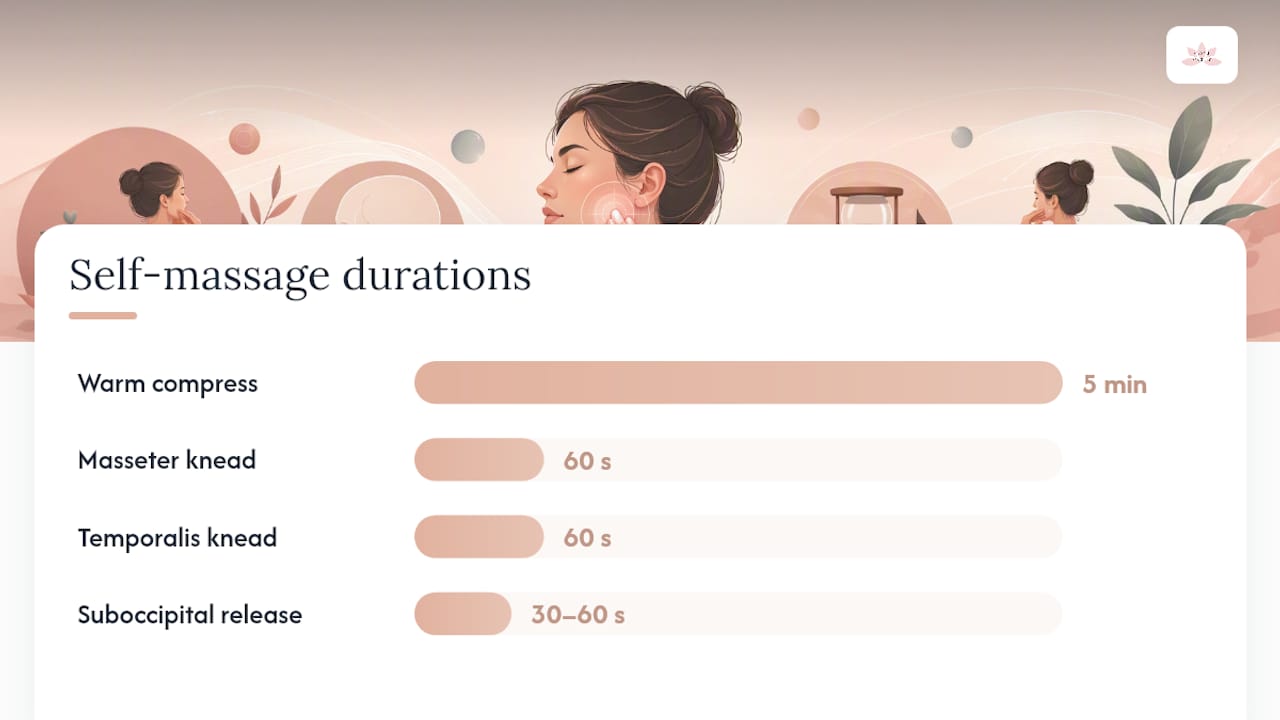
Warm up first. Apply a warm compress to your jaw for five minutes and wash your hands before touching your face.
Find your masseter. Clench your teeth gently and feel for the muscle that bulges at the back of your jaw, just in front of your ear. Release the clench before massaging.
Knead in small circles. Using two fingers, apply gentle to moderate pressure in small circular motions along the masseter for about 60 seconds per side.
Move to the temporalis. Repeat the same circular kneading on your temple area, above and slightly forward of your ear, for another 60 seconds per side.
Release the neck. Finish with a gentle suboccipital release: interlace your fingers behind your head, thumbs pointing down, and apply light pressure at the base of the skull for 30 to 60 seconds.
Repeat once or twice daily, adjusting pressure based on how your jaw responds.
Pro Tip: If a spot feels unusually sore two days after self-massage, that’s your body telling you to ease off pressure next time, not a sign to push harder. Self-massage guidance from Kaiser Permanente notes this kind of experimentation with pressure and spot selection is normal, but persistent soreness afterward is a cue to scale back or get a professional opinion.
Stop and consult a provider if self-massage triggers sharp pain, dizziness, or worsening jaw locking rather than gradual relief.
How many sessions before you notice real improvement
Some people feel less pain after a single session, but that fast relief doesn’t necessarily mean the underlying muscle tightness has resolved. Objective gains in mouth opening usually take a few repeated visits to show up reliably.
Many trials note measurable pain and mobility changes emerging after 4 to 6 sessions
Bioelectrical improvements in masseter muscle activity, measured by sEMG, tend to appear after roughly 5 to 10 sessions in manual therapy protocols
Maintenance beyond the initial course usually relies on continuing a home exercise routine rather than ongoing weekly massage indefinitely
If you’re not seeing any change in pain or mobility after six sessions, that’s a reasonable point to reassess the technique or diagnosis with your provider rather than continuing the same plan unchanged.
Why combining massage with exercise works better than massage alone
Massage loosens tight muscle, but it doesn’t retrain the jaw’s movement pattern on its own. That’s the job of therapeutic exercise, and the research is fairly blunt about the gap between the two approaches used separately versus together.
Pairing massage with post-isometric relaxation exercises produces significantly better pain and mouth-opening outcomes than massage alone, based on a randomized controlled trial comparing the two protocols directly
Splints and short courses of medication remain reasonable adjuncts for acute flare-ups, but they’re generally framed as temporary support rather than a long-term standalone solution
Modalities like low-level laser therapy, ultrasound, and TENS have some supportive evidence but tend to be used as add-ons rather than replacements for manual therapy and exercise
Coordinated care between physiotherapists, dentists, and physicians often produces better outcomes than any single provider working in isolation, particularly when jaw pain overlaps with headaches or neck tension
This combined approach also holds up on cost and safety grounds. Non-pharmacological methods like massage and exercise appear to be a safer long-term alternative to routine pharmacotherapy, which can bring side effects and often delivers only short-lived relief compared to sustained manual therapy programs.
Safety, contraindications, and when to see a professional
Self-massage and clinical TMJ work are generally low-risk, but a few situations call for caution or a different care path altogether.
Avoid massage over open wounds, active skin or dental infections near the jaw, or recent unstable trauma to the face or jaw joint until a professional has cleared the area. Mild soreness or slight fatigue in the jaw muscles for a day or two after a session is normal and usually resolves on its own.
Seek urgent assessment if you notice:
Numbness or tingling spreading into the face
Progressive muscle weakness rather than temporary fatigue
Fever alongside jaw swelling
Severe or rapidly worsening swelling in the jaw or neck area
These symptoms point to something beyond typical muscular TMJ dysfunction and need a regulated clinician’s evaluation rather than continued self-treatment.
How Bloom Society approaches TMJ-related jaw pain
Jaw pain rarely shows up in isolation. It tends to travel with neck tension, stress, and sometimes sleep disruption, which is why a purely mechanical fix often falls short.
Bloom Society is a Nurse Practitioner-led clinic built around that broader view. Assessment comes first: a practitioner looks at jaw mechanics alongside the muscles and habits feeding into it, then builds a plan that can include guided massage, a home exercise routine, and referral to another provider when the case calls for it. That integrated structure, medical assessment paired with hands-on treatment and a clear next step, is the throughline of how the clinic handles jaw tension and related discomfort.
What this evidence actually tells you to do
Here’s what the research doesn’t support: treating TMJ massage as a one-and-done fix, or treating it as useless because relief didn’t feel permanent after a single visit. Both extremes miss what the trials actually show.
The conventional advice online tends to oversell either the massage or the exercise, rarely both together. That’s backwards. The data consistently favours combined care, and the studies with the weakest long-term results are almost always the ones testing massage in isolation. If you’re only doing one half of that equation, you’re leaving results on the table.
The other thing worth saying plainly: don’t ignore your neck. Plenty of people massage their jaw for months, get partial relief, and never touch the muscles at the base of their skull that were probably contributing to the problem the whole time. If your jaw pain keeps circling back despite consistent self-massage, that’s usually the first place to look, and it’s a good reason to get an actual assessment rather than keep guessing at home.
— Aida
Book a jaw pain assessment with Bloom Society
If self-massage has helped but hasn’t resolved things, an in-person assessment is where the research actually points. Bloom Society is the option for readers in Windsor–Essex who want a Nurse Practitioner to evaluate the jaw directly, rather than piecing together advice from articles alone. The clinic’s approach folds massage into a broader plan personalized to your goals and symptoms, whether that means hands-on treatment, a home exercise prescription, or a referral if something outside its scope needs attention.

A first visit typically starts with a discussion of your history and a hands-on check of jaw movement and muscle tenderness before any treatment begins. That’s the point where a general self-massage routine turns into a plan built around what your jaw actually needs. If jaw tension is tangled up with broader stress or facial tightness, it’s also worth asking about the clinic’s relaxation and skincare treatments, which address overlapping muscle groups. You can see the full range of services on the Bloom Society site or go straight to booking an appointment online to get an assessment on the calendar.
This article is general information, not a substitute for advice from a qualified doctor. Consult a qualified healthcare professional about your own circumstances before acting on anything here.
FAQ
Is it good to massage TMJ?
Yes, for most people, massaging the muscles around the jaw joint reduces pain and improves how wide the mouth opens, according to randomized trial data. Results are strongest when massage is paired with therapeutic jaw exercises rather than done alone.
How often should you have a TMJ massage?
Many clinical protocols show measurable improvement after 4 to 6 sessions, with some studies noting continued bioelectrical gains up to 10 sessions. At home, once or twice daily self-massage is a reasonable starting frequency, adjusted based on how your jaw responds.
What are the emotional causes of TMJ pain?
Stress and anxiety commonly contribute to jaw clenching and grinding, which tightens the masseter and temporalis muscles over time, as discussed in jaw tension contributors and self-care routines on the Flossy lifestyle blog. Massage helps partly through parasympathetic activation, a genuine calming effect on the nervous system rather than just muscular relief.
Does TMJ ever fully go away?
For many people, symptoms improve substantially or resolve with consistent treatment combining massage, exercise, and, when needed, splints or short-term medication. Others manage TMJ as an intermittent condition tied to stress or posture, which is why an initial assessment with a provider like those at Bloom Society matters for setting realistic expectations.
Recommended
Comments