


Botox in Canada: Expect 3–4 Months Cosmetic, 6+ Months Medical

Botox typically lasts about three to four months for cosmetic use on the forehead, frown lines, and crow’s feet, with full results visible around the two-week mark. Therapeutic doses for migraine or excessive sweating often last longer, sometimes six months or more. Individual factors like muscle strength, dose, and metabolism shift that window in either direction, so no single number applies to everyone.
TL;DR:
Longer-lasting effects are typically seen with higher doses and precise injection placement, especially in medical treatments like migraines and hyperhidrosis.
Results are generally shortest on the outer face areas such as crow’s feet and can vary based on individual muscle strength, age, and metabolism.
The two-week follow-up is crucial for adjusting doses or injection sites to extend the duration of results, rather than rushing to schedule repeat sessions.
The safe minimum interval between treatments is three months, with adjustments based on personal muscle response and metabolism to avoid over-treatment.
Most side effects are mild and temporary, but breathing or swallowing difficulties are rare and require immediate medical attention.
Table of Contents
How long does Botox last: the onset and full-effect timeline
Most people notice the first change within three to five days, and by day seven a real difference is usually visible. Full effect tends to arrive by day 14, though some clinical sources describe subtle continued smoothing up to the 30-day mark as the muscle settles into its new pattern.
If this is your first treatment, don’t be surprised if results feel a touch shorter than what a friend describes after their third or fourth round. That’s normal, and it’s one reason many clinicians book a two-week check in.
Days 3 to 5: Early softening begins
Day 7: Noticeable change for most patients
Day 14: Full effect in the treated area, per StatPearls
Up to day 30: Minor additional refinement possible
That two-week follow-up matters more than most people realize. It’s the point where your injector can see whether the dose landed exactly right, or whether a small adjustment next time would extend how long the results hold.
How long Botox lasts by treatment area
Duration isn’t uniform across the face, and it isn’t uniform between cosmetic and medical uses either. The muscle being treated, the dose used, and the reason for treatment all push the timeline in different directions.
Forehead and glabellar lines (the “11s” between the brows): Typically lasts several months, according to the BOTOX Cosmetic product monograph
Crow’s feet: Often shorter, with reports suggesting duration varies but generally shorter than other areas, per Medical News Today
Chronic migraine: Treated on a structured protocol with maintenance sessions at regular intervals
Axillary hyperhidrosis (excessive underarm sweating): Often lasts longer than typical cosmetic uses
The pattern here isn’t random. Medical indications generally use larger total doses spread across more injection points than a typical cosmetic session, and that higher dose is a big part of why the effect holds longer. A migraine protocol or a hyperhidrosis treatment simply puts more units into play than smoothing a frown line does, which is worth understanding before you compare notes with someone getting Botox for a different reason.
What actually changes how long your results hold
Duration comes down to a handful of variables, and some of them are within your control while others aren’t.
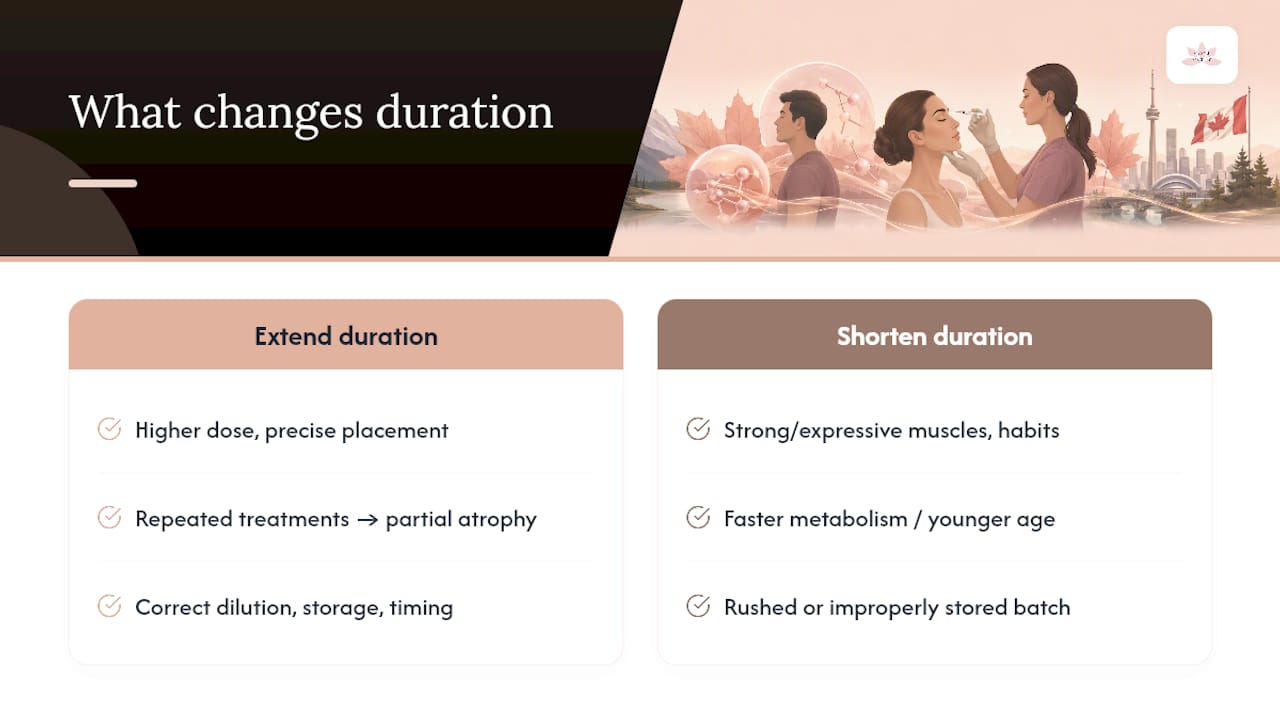
Dose and injection placement drive most of the variation you’ll see between two people treating the exact same area. More units, placed precisely into the target muscle, tend to produce a longer-lasting result than a lighter dose spread loosely across the same zone. Muscle strength plays a similar role: someone with a naturally strong, expressive frontalis (the forehead muscle) or a habit of raising their eyebrows constantly will often burn through the effect faster than someone with a quieter resting expression, and that person may need a slightly higher unit count from the start.
Metabolism and age matter too, though less predictably. Faster metabolic rates can shorten how long the toxin’s effect persists, and it’s part of why a 28-year-old and a 55-year-old sometimes report different timelines from what looks like an identical treatment.
Technique matters more than patients usually assume. Correct dilution, proper storage, and administering the product within the window set by the manufacturer’s dosing and injection guide all affect potency at the point of injection. A rushed or improperly stored batch simply won’t perform the same way.
One counterintuitive finding: results often get more durable over time, not less. Repeated treatments can lead to longer-lasting effects because a muscle that’s been relaxed repeatedly tends to partially atrophy and contract with less force, according to NCBI research.
Pro Tip: If your results wore off noticeably faster than expected, don’t assume you need to book sooner next time. Talk to your injector about adjusting the dose or the injection pattern first. Chasing duration by shortening the interval between appointments is the wrong fix.
When to book your next Botox appointment
Scheduling retreatment isn’t just about when the wrinkles start creeping back. There’s a safety floor built into the product itself.
Respect the interval minimum. The BOTOX Cosmetic monograph advises against retreating more frequently than every few months for cosmetic dosing, and that’s not a marketing suggestion, it’s a safety guideline tied to how the toxin clears the body.
Plan around the typical 3 to 4 month cadence. Most cosmetic patients land somewhere in this window for maintenance, though therapeutic protocols like the 12-week migraine schedule follow their own structured cycle.
Let your clinician adjust dose, not just timing. If results are fading early and often, the conversation should be about unit count or placement, not about squeezing appointments closer together.
Think of the “rule of 3” as a floor, not a target. It sets the minimum safe interval; your actual best interval depends on how your specific muscles and metabolism respond, something only your injector can judge over a couple of sessions.
What side effects should you expect, and when should you worry?
Most reactions to Botox are minor and predictable. Bruising, mild swelling, tenderness at the injection site, and an occasional headache in the first day or two are common and usually resolve on their own within a week.
A temporary eyelid droop or slight facial asymmetry can happen, particularly with forehead or brow treatments, and it typically resolves as the toxin wears off over the following weeks. This is uncomfortable but not dangerous.
What genuinely warrants urgent attention is different, and rare. Health Canada and the product monograph both flag that the toxin can, in very rare cases, spread beyond the injection site and affect breathing or swallowing. Anyone with pre-existing breathing or swallowing difficulty is considered higher risk and should discuss this directly with their injector before treatment. Difficulty breathing or swallowing after a Botox appointment is a reason to seek medical care immediately, not to wait it out.
Bruising or swelling: common, resolves within days
Mild headache: common, short-lived
Temporary eyelid droop: uncommon, self-resolving
Breathing or swallowing difficulty: rare, seek care immediately
On the practical side, avoiding blood thinners like aspirin before your appointment (where medically appropriate) and skipping intense exercise for 24 hours afterward both reduce bruising risk. Bloom Society’s pre and post procedure guidelines walk through this in more detail if you want to prep properly before your next session.
How Bloom Society approaches Botox duration and follow-up
Bloom Society is a nurse practitioner-led clinic, and that matters for a treatment where dosing precision drives how long results actually last. Every consultation starts with a muscle assessment and a review of your prior treatment history, not a flat, one-size-fits-all unit count.
That personalized approach carries into the follow-up plan too. Rather than defaulting everyone to the same three-month rebooking, Bloom Society’s beginner Botox and dermal filler sessions build a maintenance schedule around how your specific muscles responded the first time.
The gap between what patients expect and what actually happens
Here’s what the research and clinical guidance actually support: duration is a range, not a number, and most of the marketing language around Botox treats it like a fixed product spec. It isn’t. A 3 to 4 month average hides real variation driven by dose, muscle strength, and metabolism, and pretending otherwise sets patients up to feel like something went wrong when their results fade a little early or hold a little longer than a friend’s.
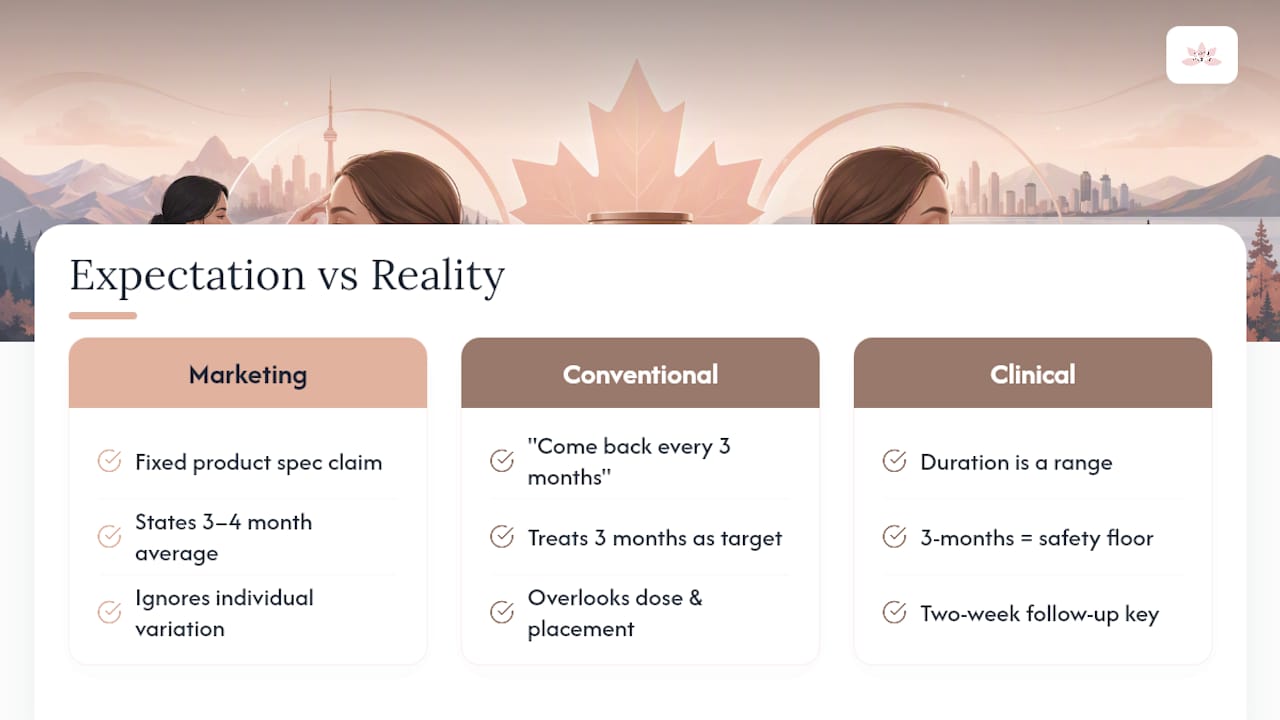
The conventional advice, “just come back every three months,” also misses something important. The three-month rule is a safety floor, not a target, and rigid scheduling without reassessment ignores the fact that dose and placement matter more than timing once you’re past that minimum interval.
If there’s one thing worth prioritizing, it’s the two-week follow-up. That single check-in tells you and your clinician more about your actual response than any generic timeline ever could, and it’s the foundation for getting your next appointment right instead of just guessing.
— Aida
Booking a Botox consultation with Bloom Society
A consultation at Bloom Society starts with an honest assessment, not a sales pitch. Your nurse practitioner looks at your muscle strength, treatment history, and goals, then suggests a unit count and a realistic timeline based on your specific case, not a generic average pulled from a brochure.

That personalized starting point is the real difference between booking with a clinic built around individual assessment and just picking whatever unit count worked for someone else. If you’re ready to see what a tailored plan looks like for your own face and goals, the injectables page walks through what’s included, and you can book online directly when you’re ready. Results vary from person to person, and that’s exactly why the assessment comes first.
This article is general information, not a substitute for advice from a qualified doctor. Consult a qualified healthcare professional about your own circumstances before acting on anything here.
Sources
FAQ
What happens after 10 years of Botox?
Long-term, repeated use tends to produce longer-lasting results per treatment because the treated muscle partially atrophies and contracts with less force over time. There’s no evidence that a decade of appropriately spaced treatments causes permanent damage when administered by a qualified injector.
What is the “rule of 3” in Botox?
It refers to the minimum three-month interval between cosmetic retreatments recommended in the product monograph, along with the general observation that most cosmetic effects last roughly three to four months. It’s a safety floor and a rough average, not a guarantee for every patient.
What are the downsides of Botox?
The main downsides are temporary: bruising, swelling, mild headache, and occasionally a short-lived eyelid droop or asymmetry. Serious complications like breathing or swallowing difficulty are rare but require immediate medical attention when they occur.
Why are some younger people skipping Botox?
Some younger adults are choosing to delay cosmetic Botox, often citing a preference for prevention-focused skincare or simply wanting to age without early intervention. That’s a personal choice rather than a safety concern, since the treatment itself remains a standard, well-studied option at any adult age when medically appropriate.
Recommended
Comments